MES vs CMMS: What’s the Difference, and Which One Do You Need?
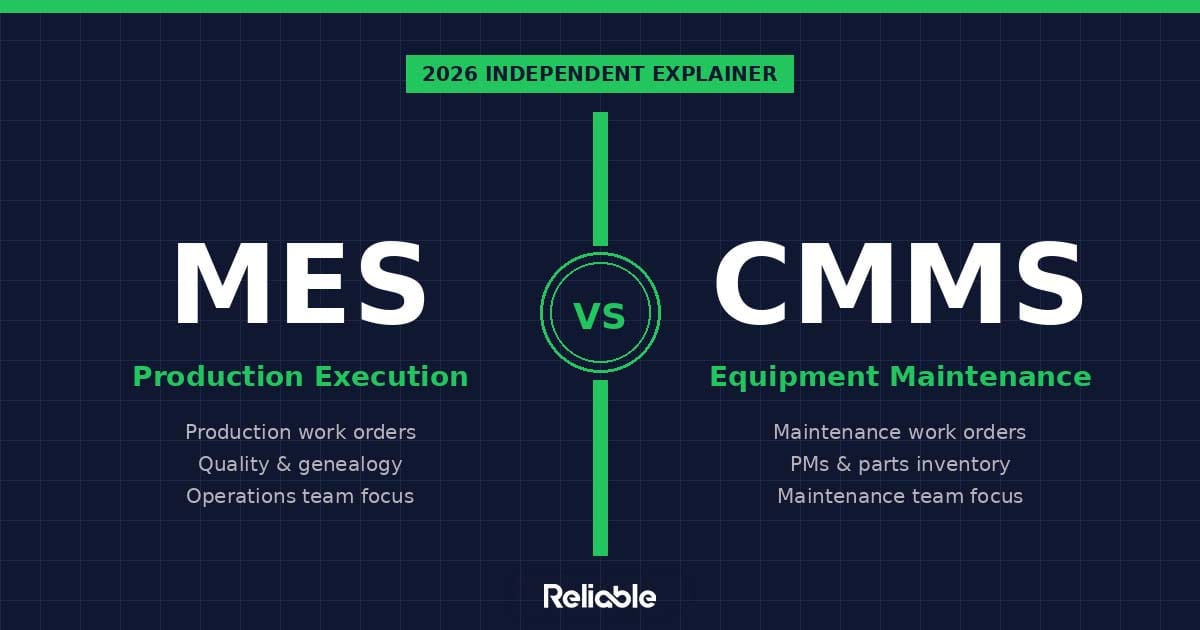
TL;DR: MES and CMMS share terminology and touch the same equipment, but they solve different problems. MES (Manufacturing Execution System) orchestrates production - routing production work orders to machines, tracking output, enforcing quality, and capturing genealogy. CMMS (Computerized Maintenance Management System) keeps equipment running — scheduling preventive maintenance, managing repair work orders, tracking parts inventory, and documenting maintenance history. The same machine appears in both systems but in different roles: a production resource in MES, a maintained asset in CMMS. Most serious manufacturers need both. They integrate at three primary handshake points: downtime events, asset master alignment, and equipment availability. CMMS is usually implemented first because maintenance is operationally fundamental. MES is added when production execution capability becomes the constraint or when regulatory compliance forces it.
The Short Answer
MES makes products. CMMS keeps the equipment that makes products running. If you only remember one thing from this explainer, remember the role each system assigns to a machine. MES sees a machine as a production resource - something that consumes raw material, performs operations, and produces finished goods. CMMS sees the same machine as a maintained asset - something that wears, requires lubrication, needs calibration, and eventually fails. Both views are correct. They describe different facets of the same physical equipment, captured in different systems for different purposes.
Why the Confusion Exists
Three reasons make MES and CMMS easier to confuse than most enterprise software categories. Both use the word "work order." An MES work order is a production work order - make 500 units of product X on line 3 by Friday. A CMMS work order is a maintenance work order - replace the bearings on pump 47, scheduled for Tuesday. The terminology is identical; the workflow, data model, and operational meaning are entirely different. Buyers reading vendor marketing often see "work order management" capabilities described in similar language across both categories without realizing the work orders themselves are not the same thing. Both interact with the same physical equipment. A CNC machine, a packaging line, a tableting press - these are the assets where MES and CMMS overlap. Both systems track the equipment, both record events that happen to the equipment, and both produce reports about equipment performance. The asset hierarchy in CMMS and the production resource hierarchy in MES are often near-identical. Without understanding the role distinction, the systems can look redundant. Vendors deliberately blur the line. MES platforms increasingly include maintenance modules and asset management capabilities. CMMS platforms increasingly include production-adjacent features and OEE dashboards. Both categories want to expand their addressable market by claiming capability in the other's territory. The capability is rarely as deep as the marketing suggests, but the marketing creates real buyer confusion about which system to deploy.
The ISA-95 Framing
The international standard for manufacturing operations integration - ISA-95, covered in our MES vs ERP explainer — places both MES and CMMS at Level 3 (manufacturing operations management). They are not separated by ISA-95 level, which is part of why the categories are easy to confuse. Within Level 3, the standard distinguishes between functional groupings:
Production operations management - production execution, dispatching, tracking. This is MES territory.
Maintenance operations management - maintenance execution, work order management, parts inventory. This is CMMS territory.
Quality operations management - quality testing, holds, dispositions. This is sometimes part of MES, sometimes a separate quality management system.
Inventory operations management - material tracking on the shop floor. Shared between MES and warehouse management.
The ISA-95 view treats MES and CMMS as parallel systems within Level 3, integrating with each other and both integrating with Level 4 (ERP) above and Level 2 (control systems) below. The two systems are complementary, not competitive - and the standard explicitly defines them as different functional domains within manufacturing operations.
What MES Does
MES manages production execution on the shop floor. The core capabilities are:
Production order execution - releasing work to lines and machines, dispatching, sequencing, and routing in real time
Real-time machine data integration - connecting to PLCs, SCADA, and historians to capture machine state, cycle counts, and equipment events
Quality management - in-process quality checks, statistical process control, non-conformance handling, hold and release
Traceability and genealogy - tracking what materials went into what products, on which equipment, by which operators, at what time
Electronic batch records and work instructions - guiding operators through production steps, capturing electronic signatures, producing audit-ready documentation
OEE and production performance - measuring availability, performance, and quality in real time, with downtime reasons and root cause analysis
Labor and material tracking - capturing actual labor hours and material consumption against work orders
MES is the system of record for production. It owns the data about what actually happened on the shop floor — cycle times, quality events, downtime, scrap, operator activity, machine state — at a level of granularity that other systems cannot match. The major MES platforms covered in our MES platforms guide include Plex (Rockwell), Siemens Opcenter, GE Vernova Proficy, Tulip, Aegis FactoryLogix, and Critical Manufacturing.
What CMMS Does
CMMS manages maintenance execution and equipment reliability. The core capabilities are:
Preventive maintenance scheduling - calendar-based, meter-based, and condition-based PM triggers with route-based scheduling for maintenance technicians
Work order management - repair work orders, planned maintenance work orders, request-to-completion workflow with technician assignment and parts allocation
Asset management and history - equipment hierarchy, asset records, full maintenance history, repair documentation, failure analysis
Parts and inventory management - spare parts inventory, reorder points, parts consumption tracking, supplier management
Mobile technician execution - work order completion in the field, photo capture, time tracking, parts checkout
Maintenance KPIs - MTBF, MTTR, PM compliance, schedule adherence, maintenance cost per asset
Compliance documentation - calibration records, inspection logs, regulatory documentation for industries where maintenance is regulated
CMMS is the system of record for equipment reliability. It owns the maintenance history of every asset - every PM completed, every repair performed, every failure root cause, every part consumed - that drives reliability decisions and equipment replacement strategy. The major CMMS platforms covered in our CMMS guide include MaintainX, Limble, eMaint, Fiix, UpKeep, and Coast.
Side-by-Side Comparison
| Dimension | MES | CMMS |
|---|---|---|
| Primary Function | Production execution | Equipment maintenance |
| Primary Question | Are we making the product correctly? | Is the equipment reliable and available? |
| Equipment Role | Production resource | Maintained asset |
| Work Order Type | Production work orders | Maintenance work orders |
| Primary Users | Operators, supervisors, quality | Maintenance technicians, planners |
| Time Horizon | Seconds to hours | Hours to weeks |
| Key Outputs | OEE, genealogy, batch records | MTBF, MTTR, PM compliance |
| Typical Vendors | Plex, Siemens Opcenter, Proficy, Tulip | MaintainX, Limble, eMaint, Fiix |
| Implementation | 3-24 months depending on scope | 2 weeks to 6 months |
The Overlap Zone (and Where Vendors Confuse Buyers)
Three areas of legitimate overlap between MES and CMMS create most of the buyer confusion. Downtime tracking. When a machine stops, both systems should know about it. MES records the production loss - lost cycles, missed schedule, OEE impact, downtime reason code. CMMS records the maintenance response - work order, technician hours, parts consumed, failure root cause, repair documentation. The same downtime event lives in both systems, capturing different facets. Vendors marketing MES platforms with downtime tracking sometimes suggest this replaces CMMS downtime management. It does not. MES downtime is a production data point; CMMS downtime is a maintenance event with a full repair workflow attached. Both are needed for serious operations. Work orders on equipment. Both systems issue work orders that route to equipment. The MES production work order routes a make-the-product instruction to a machine. The CMMS maintenance work order routes a fix-or-maintain-the-machine instruction to the same machine. Vendors that describe their platform as "single work order system" usually mean one of two things: either the platform handles only one type of work order (and the buyer must integrate with another system for the other type), or the platform attempts to handle both with a single data model that compromises one of the workflows. Neither is ideal for operations where production and maintenance are both serious functions. Asset hierarchy. MES tracks production resources in a hierarchy (plant, area, line, cell, machine). CMMS tracks maintained assets in a hierarchy (site, building, system, equipment, component). The hierarchies are similar in structure but reflect different views of the same physical world. MES cares about how production flows through the equipment; CMMS cares about how the equipment is maintained as physical assets. Modern integrations align the two hierarchies through shared asset IDs while letting each system maintain its own view. Buyers who try to consolidate the hierarchies into a single source generally end up compromising both systems.
How MES and CMMS Integrate
Integration between MES and CMMS happens at three primary handshake points. Each one is operationally important and each one is commonly broken in practice. The downtime event handshake. When a machine goes down, MES detects the production loss in real time from machine data. CMMS issues a maintenance work order to address the failure. The systems should share the downtime event with consistent timestamps, downtime reason codes, work order references, and resolution timestamps. Done well, this lets reliability engineers correlate production loss with maintenance response and analyze which failure modes drive the most operational impact. Done poorly, MES and CMMS report different downtime numbers because they captured the same event differently - which undermines reporting credibility for both systems. The asset master handshake. Both systems need to reference the same physical equipment with consistent IDs. The asset master integration aligns the equipment hierarchy so a pump in CMMS is the same pump in MES, regardless of which system the data flows through. The right architecture typically designates one system as the master (usually CMMS, because the maintenance team owns the asset records most rigorously) and replicates the asset master to the other system through scheduled sync or API integration. Without this alignment, downtime events, work orders, and reports cannot be correlated across systems. The equipment availability handshake. CMMS knows when planned maintenance windows will take equipment offline. MES needs to know this so production scheduling can avoid scheduling work that will be interrupted. The integration pushes scheduled maintenance windows from CMMS up to MES, where the production scheduler treats them as unavailable capacity. The reverse direction matters too - when MES schedules production windows, CMMS planners need visibility so they can plan maintenance during natural production gaps rather than competing for the same equipment time. Modern integrations use middleware platforms (MuleSoft, Boomi, webMethods) or direct API connections between the systems. ISA-95 Part 5 defines B2MML data structures that some MES platforms use for these exchanges. The integration quality is one of the most important - and most often underestimated - factors in how well MES and CMMS function together.
When CMMS Alone Is Enough
Some manufacturing operations need CMMS but not MES. This is more common than buyers realize:
Smaller manufacturers with simple production execution where ERP shop floor modules cover basic production needs and a dedicated MES would be over-scoped
Job shops and engineer-to-order operations where each project is unique and traceability is documented at the project level rather than through MES genealogy
Distribution and assembly operations where the manufacturing component is simple kitting or final assembly without complex production execution requirements
Operations without serious quality enforcement or regulatory traceability requirements where ERP can document production at the work order level adequately
For these operations, CMMS handles maintenance management as a standalone function. ERP handles production planning and basic shop floor control. MES would add cost and complexity without proportionate value. Manufacturers in this segment should still validate that ERP shop floor capabilities meet their actual production execution needs before assuming MES is unnecessary.
When MES Alone Is Enough
MES alone - without CMMS - is unusual. The scenarios are narrow:
Operations with outsourced maintenance where the maintenance contractor uses their own CMMS and the manufacturer does not need internal maintenance management
Operations with very simple maintenance where a few maintenance work orders per month can be tracked in the MES maintenance module or even in a spreadsheet without CMMS-grade workflow
Operations where MES platforms with deep maintenance modules (such as Plex Smart Manufacturing Platform with its asset management capabilities) cover the maintenance scope adequately
In practice, manufacturers running on MES alone usually have under-built maintenance programs that show up later as reliability problems. The cost-effective answer for most operations is CMMS first, MES added when production complexity justifies it.
When You Definitely Need Both
Most serious manufacturers need both MES and CMMS. The scenarios that make both effectively required: Regulated industries. Pharmaceutical manufacturing, food and beverage, aerospace, and medical device manufacturing all require maintenance documentation (calibration records, equipment qualification, validated state) that CMMS produces and production documentation (electronic batch records, genealogy, traceability) that MES produces. Both regulatory burdens land on manufacturing operations and neither system can produce the other's documentation. Operations with serious OEE measurement. Real OEE measurement requires MES to capture production data and CMMS to capture maintenance events. The downtime that drives availability losses lives in both systems and needs both to be analyzed properly. Operations without one or the other cannot measure OEE accurately. Capital-intensive manufacturing. Operations with expensive equipment - semiconductor fabs, chemical plants, refineries, automotive assembly - depend on both systems to coordinate production and maintenance. The cost of unplanned downtime makes the integration between MES and CMMS operationally critical, not optional. Mature operations. Most manufacturing operations that have been running for more than 5 years and have professional maintenance teams have both systems, even if the implementations are imperfect. Manufacturers without both at this scale typically have an undermanaged side - usually maintenance - that shows up as reliability problems.
If You Only Have Budget for One: Start with CMMS
For most manufacturers building toward both systems, CMMS comes first. The reasoning is operational. Equipment that is not maintained eventually fails, which makes any production execution investment moot. CMMS is also typically lower cost than MES, with faster implementation timelines (weeks to months versus months to years) and quicker time-to-value. Maintenance discipline built through a CMMS implementation creates organizational habits - work order completion, PM compliance, parts management - that benefit any subsequent MES deployment. The exception is regulated industries where MES is required for compliance. Pharmaceutical operations under FDA 21 CFR Part 11 cannot run without electronic batch records, which makes MES effectively mandatory regardless of maintenance maturity. Food and beverage operations under FSMA face similar pressures. For these manufacturers, MES is sometimes deployed first because the regulatory exposure is the more urgent risk, with CMMS following once compliance is stabilized. The wrong sequence is implementing MES first in non-regulated operations on the assumption that "production data will tell us what to maintain." It rarely does. Production data tells you which equipment ran and which equipment stopped, but the analysis required to convert that into a maintenance program needs CMMS infrastructure (asset hierarchy, work order workflow, technician execution) that does not exist if CMMS is not implemented.
The Honest Middle Ground
MES and CMMS selection is a category where vendor positioning frequently outpaces operational reality. MES vendors will tell you their maintenance modules eliminate the need for CMMS. CMMS vendors will tell you their production-adjacent features eliminate the need for MES. Both claims are usually wrong for serious operations, even when the modules in question are technically functional. The right answer is honest assessment of operational complexity. Three diagnostic questions usually clarify the right architecture:
Do you have a serious maintenance team? If yes, you need a dedicated CMMS. Maintenance team productivity depends on CMMS-grade workflow that MES maintenance modules rarely provide.
Do you need real-time production data, quality enforcement, or regulatory traceability? If yes, you need MES. CMMS does not produce these capabilities and ERP shop floor modules generally fall short.
Do you measure OEE seriously? If yes, you need both. OEE without integrated MES and CMMS data tells an incomplete story about availability losses.
Most manufacturers above the smallest scale answer yes to at least two of these. The operational answer is to deploy both systems, integrate them at the downtime event, asset master, and equipment availability handshakes, and treat the integration quality as a primary selection criterion rather than an afterthought.
Frequently Asked Questions
What is the difference between MES and CMMS?
MES (Manufacturing Execution System) orchestrates production on the shop floor — routing production work orders to machines, tracking output, enforcing quality, and capturing genealogy. MES owns the answer to whether the product is being made correctly right now. CMMS (Computerized Maintenance Management System) keeps equipment running — scheduling preventive maintenance, managing repair work orders, tracking parts inventory, and documenting maintenance history. CMMS owns the answer to whether the equipment is available and reliable. Both systems interact with the same physical equipment, but MES sees machines as production resources while CMMS sees them as maintained assets. MES makes products. CMMS keeps the equipment that makes products running.
Do I need both MES and CMMS?
Most serious manufacturers need both. CMMS is required for any operation with maintenance teams, preventive maintenance programs, or equipment downtime tracking — which is essentially every manufacturer. MES becomes important when production execution requires real-time data, quality enforcement, traceability for regulatory compliance, or accurate OEE measurement. Manufacturers with both systems typically integrate them at the downtime event handshake, where MES captures production loss and CMMS captures the maintenance response. The exception is some smaller operations where ERP shop floor modules cover basic MES needs, and dedicated CMMS handles maintenance independently.
Why do MES and CMMS both have work orders?
MES and CMMS both use the term work order, but they refer to different things. An MES work order is a production work order — make this product, on this line, in this quantity, by this time. A CMMS work order is a maintenance work order — fix this pump, lubricate this gearbox, inspect this conveyor. The same physical machine appears in both systems, but in different roles. The MES sees the machine as a production resource that consumes a production work order to make a product. The CMMS sees the machine as a maintained asset that requires maintenance work orders to stay reliable. Vendors that claim a single work order system replaces both are usually conflating two distinct workflows that share terminology but not function.
How do MES and CMMS integrate?
MES and CMMS integrate at three primary handshake points. The downtime event handshake is most important: when a machine goes down, MES captures the production loss while CMMS captures the maintenance response — the systems should share downtime reasons, work order references, and resolution timestamps. The asset master handshake aligns the equipment hierarchy so both systems reference the same physical assets with consistent IDs. The equipment availability handshake lets CMMS push planned maintenance windows up to MES so production scheduling can avoid them. Modern integrations use middleware platforms or direct API connections. Poor integration creates duplicate data entry and reporting discrepancies that undermine both systems.
Can MES replace CMMS?
Generally no. Some MES platforms include maintenance modules that handle simple work order tracking, but the depth of preventive maintenance scheduling, parts inventory management, and maintenance history rarely matches dedicated CMMS platforms. MES platforms with maintenance modules — Plex Smart Manufacturing Platform, Siemens Opcenter Asset Management, Tulip's maintenance apps — work for low-complexity maintenance scenarios but typically fall short for operations with significant maintenance teams, complex parts inventory, regulatory documentation requirements, or full asset lifecycle tracking. Manufacturers with serious maintenance operations almost always deploy a dedicated CMMS or EAM alongside MES.
Can CMMS replace MES?
No. CMMS does not perform production execution functions — it does not orchestrate production work orders, track real-time production output, enforce in-process quality, capture product genealogy, or measure OEE from machine data. Some CMMS platforms include features that touch production-adjacent capabilities, but the core MES functions of production orchestration and execution are not part of the CMMS data model. Manufacturers that need MES capabilities must deploy MES — extending CMMS to cover production execution generally fails. The two systems are complementary, not substitutes.
If I only have budget for one, should I implement MES or CMMS first?
For most operations, CMMS comes first. Maintenance is operationally fundamental — equipment that is not maintained eventually stops working, which makes any MES investment pointless. CMMS is also typically lower cost and faster to implement than MES, with quicker time-to-value. The exception is manufacturers in regulated industries (pharmaceutical, food, aerospace) where MES is effectively required for compliance. For these operations, MES sometimes precedes CMMS because the regulatory exposure is the more urgent risk. Manufacturers running on spreadsheets for both should generally implement CMMS first, run it for 12 to 18 months to build maintenance discipline, then add MES when production execution capability becomes the constraint.
Related Guides
CMMS vs EAM: What's the Difference, and Which One Do You Need?
MES vs ERP: What's the Difference, and Which One Do You Need?
Sources
ISA-95 standard documentation - International Society of Automation
MESA International - Manufacturing Enterprise Solutions Association reference architecture
Plex Smart Manufacturing Platform documentation - rockwellautomation.com
Siemens Opcenter MES and Asset Management documentation - sw.siemens.com
MaintainX product documentation - getmaintainx.com
Limble CMMS product documentation - limblecmms.com
eMaint product documentation - emaint.com
FDA 21 CFR Part 11 - Electronic Records and Electronic Signatures
FSMA - Food Safety Modernization Act traceability rules
Reliable Magazine independent editorial analysis
Last updated: April 29, 2026. This guide is editorial analysis by Reliable Magazine.