Best Industrial IoT Platforms for Manufacturing in 2026: An Independent Comparison
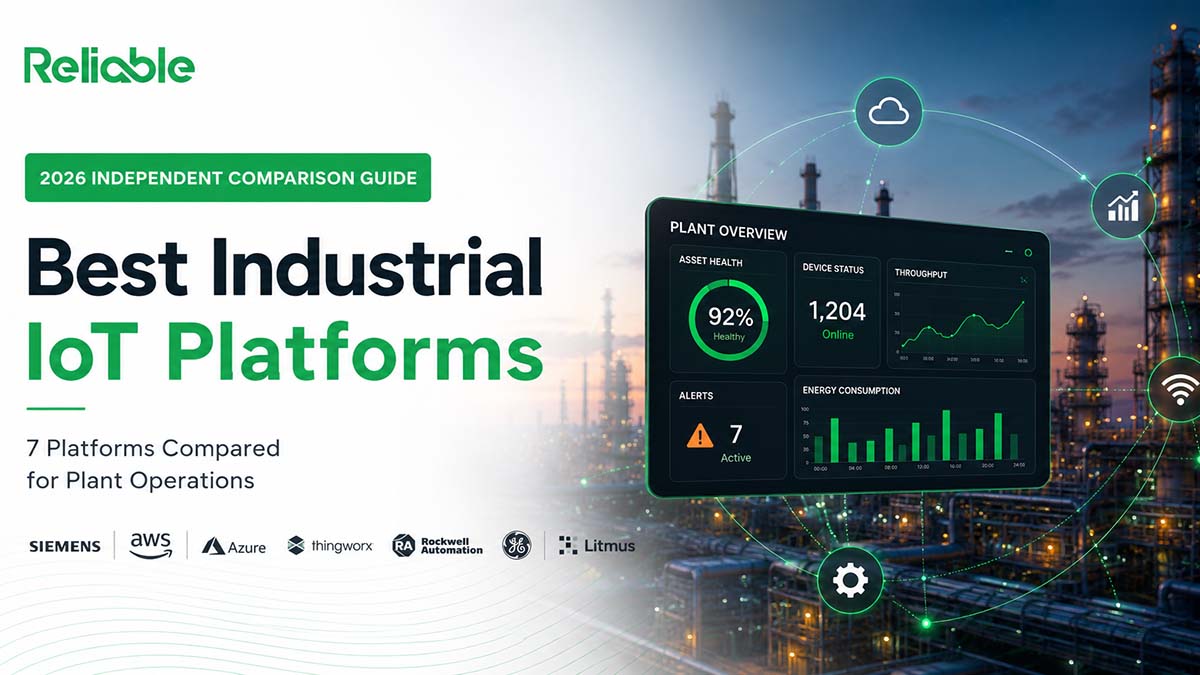
Last updated: March 2026 | By the editors at Reliable TL;DR: For Siemens-equipped plants, Insights Hub (formerly MindSphere) offers the most turnkey path to industrial IoT with native digital twin integration and OEE analytics. AWS IoT SiteWise provides the most flexible pay-as-you-go model for plants already on AWS. Microsoft Azure IoT integrates best with Dynamics 365 and Power BI for unified manufacturing analytics. PTC ThingWorx remains the deepest development platform for custom IIoT applications, though its pending sale to TPG private equity introduces transition uncertainty. Rockwell FactoryTalk connects natively to Allen-Bradley environments. For plants running mixed equipment from multiple vendors, Litmus Edge offers the best vendor-neutral approach with 250+ protocol support and no cloud lock-in. For maintenance and reliability teams, the key evaluation criterion is how easily the IIoT platform integrates with your CMMS to close the loop between condition monitoring data and maintenance work execution.
How We Evaluated
This guide compares seven industrial IoT platforms through the lens of plant operations — with particular focus on how each platform supports condition monitoring, predictive maintenance, and integration with maintenance management systems. We evaluated industrial protocol support (OPC-UA, Modbus, MQTT, Ethernet/IP), edge computing capabilities, cloud analytics depth, integration with CMMS and ERP systems, scalability from pilot to enterprise, and total cost of ownership. We reviewed analyst reports from Gartner and ARC Advisory Group, vendor documentation, and feedback from reliability engineers and plant IT teams across manufacturing, process, and utilities sectors. Reliable does not accept payment for rankings. Vendors may sponsor enhanced listings with additional detail, but editorial rankings are independent. Read our editorial policy.
7 Best Industrial IoT Platforms for 2026, Ranked by Use Case
1. Siemens Insights Hub (formerly MindSphere) — Best for Siemens Ecosystems
Siemens rebranded MindSphere to Insights Hub in 2023, expanding it from a standalone IIoT platform into the central data layer of their Industrial Operations X portfolio. For plants running Siemens PLCs, drives, and automation, Insights Hub provides the smoothest path from equipment to analytics — native connectivity to SIMATIC controllers, built-in OEE and asset health monitoring, and integration with Siemens digital twin technology. The platform uses a tiered packaging model (Essentials, Standard, Premium) with add-on packs for edge analytics, predictive learning, and remote service. Built on the Mendix low-code platform, Insights Hub allows operations teams to build custom dashboards and applications without heavy IT involvement. For maintenance and reliability teams, Insights Hub offers built-in predictive analytics that can detect anomalies in vibration, temperature, and process parameters, then trigger alerts. Integration with external CMMS platforms is possible through REST APIs, though the platform works most naturally within the broader Siemens Xcelerator ecosystem. Best for: Manufacturers with significant Siemens automation infrastructure wanting a turnkey IIoT path with digital twin integration. Pricing: Custom, based on capability package (Essentials/Standard/Premium), asset attribute size, and cloud resources. Free "Start for Free" tier available for evaluation. Enterprise deployments typically start at $50,000+/year. Protocols: Native Siemens SIMATIC connectivity, OPC-UA, MQTT, REST APIs Edge capability: Siemens Industrial Edge platform with local compute and analytics CMMS integration: API-based; strongest within Siemens ecosystem
2. AWS IoT SiteWise — Best Pay-As-You-Go IIoT
AWS IoT SiteWise is the most cost-transparent option in this guide. Its pay-as-you-go model charges per message ingested, per computation, per data point stored, and per monitor dashboard user — no platform fees, no minimums, no multi-year commitments. For plants that want to start a pilot without a six-figure purchase order, SiteWise removes the financial barrier. The platform collects data from OPC-UA servers, Modbus devices, and Ethernet/IP sources through the SiteWise Edge gateway (data collection pack is free). Asset models let you build equipment hierarchies and calculate metrics like OEE, uptime, and energy consumption. SiteWise Monitor provides no-code web portals for operations teams. The broader AWS ecosystem — Lambda, SageMaker, S3, Timestream — gives data teams powerful tools for advanced analytics and machine learning once the data is in the cloud. For maintenance teams, SiteWise can be configured to stream equipment condition data to Amazon SNS or SQS, which can then trigger work orders in connected CMMS platforms via API. AWS also offers IoT Events for rule-based alerting and anomaly detection through SiteWise's built-in ML capabilities. Best for: Plants already on AWS wanting transparent pricing, flexible scaling, and access to the full AWS analytics ecosystem. Pricing: Pay-as-you-go. Data ingestion: $1.00 per million messages. Computations: $0.20 per million. Data storage: $0.029 per GB/month. Edge data collection pack: free. Typical small-to-mid plant deployment: $500-$5,000/month depending on asset count and data frequency. Protocols: OPC-UA, Modbus TCP/RTU, Ethernet/IP via SiteWise Edge gateway Edge capability: SiteWise Edge with free data collection and paid data processing packs CMMS integration: Via AWS Lambda, SNS/SQS, or direct REST API to CMMS platforms
3. Microsoft Azure IoT — Best for Microsoft Ecosystem
Azure IoT is the natural choice for manufacturers running Microsoft infrastructure. IoT Hub handles device connectivity and message routing. Azure Digital Twins enables virtual modeling of physical plants and equipment. Azure IoT Edge pushes intelligence to the plant floor. And the entire stack connects natively to Power BI for real-time dashboards, Dynamics 365 for ERP and supply chain, and Azure AI for predictive analytics. The platform's unique strength is how seamlessly operational data flows into business systems. A vibration anomaly detected at the edge can trigger a Power Automate workflow that creates a work order in Dynamics 365, notifies the maintenance planner in Teams, and logs the event in Power BI — all within the Microsoft ecosystem. For maintenance and reliability teams already using Dynamics 365, Azure IoT provides the tightest integration between equipment condition data and maintenance management. For teams using standalone CMMS tools, Azure's REST APIs and event-driven architecture support integration with most modern platforms. Best for: Manufacturers in the Microsoft ecosystem wanting unified IoT, analytics, and business system integration. Pricing: Pay-as-you-go. IoT Hub: free tier available (8,000 messages/day), Standard tier starts at $25/month per unit (400,000 messages/day). Azure Digital Twins, Stream Analytics, and storage billed separately. Enterprise deployments scale from $1,000-$20,000+/month depending on message volume and services used. Protocols: MQTT, AMQP, HTTPS; OPC-UA via Azure IoT Edge modules Edge capability: Azure IoT Edge with containerized workloads, AI at the edge CMMS integration: Native with Dynamics 365 Asset Management; API-based with third-party CMMS
4. PTC ThingWorx — Best Enterprise IIoT Development Platform
ThingWorx is the most mature purpose-built IIoT development platform. With Kepware connectivity (supporting 150+ industrial protocols), rapid application development tools, built-in analytics, and Vuforia augmented reality integration, ThingWorx provides the most comprehensive toolkit for enterprises building custom IIoT solutions. Gartner has recognized PTC as a Visionary in Industrial IoT for two consecutive years. Important context: In late 2025, PTC announced the sale of ThingWorx and Kepware to private equity firm TPG for up to $725 million. The deal is expected to close in the first half of 2026. TPG also acquired GE Vernova's Proficy manufacturing software business, signaling an intent to build a consolidated industrial software portfolio. Existing ThingWorx customers should experience business as usual in the near term, but the ownership transition introduces uncertainty around long-term roadmap and support. For maintenance teams, ThingWorx's asset monitoring and predictive analytics capabilities are strong — remote condition monitoring, anomaly detection, and threshold-based alerting are core use cases. Kepware's protocol breadth means it can connect to virtually any equipment on the plant floor, regardless of vendor or vintage. Best for: Large enterprises building custom IIoT applications that need the broadest protocol support and a full development platform. Pricing: Custom, not published publicly. Named-user and device-based licensing. Industry benchmarks suggest mid-size deployments start at $100,000+/year. Enterprise deployments with Kepware, analytics, and Vuforia can reach $500,000+/year. Protocols: 150+ via Kepware (the broadest in the industry) Edge capability: ThingWorx Edge with local compute and store-and-forward CMMS integration: ThingWorx Flow connects to SAP, Salesforce, and other enterprise systems; REST API for CMMS platforms. Now also part of Rockwell FactoryTalk ecosystem.
5. Rockwell Automation FactoryTalk — Best for Allen-Bradley Plants
FactoryTalk is Rockwell Automation's software suite spanning MES, analytics, IIoT, and edge computing. For plants running Allen-Bradley PLCs and Rockwell automation, FactoryTalk provides the most direct path from controller data to actionable insights. FactoryTalk Optix delivers modern HMI and visualization. FactoryTalk Analytics LogixAI embeds anomaly detection directly into the control layer. FactoryTalk Hub provides cloud-based analytics and remote monitoring. Rockwell's 2023 integration of PTC ThingWorx into the FactoryTalk ecosystem (branded as FactoryTalk InnovationSuite) added IIoT development capabilities and Kepware connectivity to the portfolio. With Fiix CMMS also in the Rockwell portfolio, there's a natural integration path from equipment monitoring through maintenance execution — though in practice, these products are still somewhat siloed and integration requires configuration. For maintenance teams in Rockwell-heavy plants, FactoryTalk + Fiix represents the most vertically integrated OT-to-maintenance stack from a single vendor. Best for: Plants running Allen-Bradley PLCs and Rockwell automation wanting native OT connectivity and a path to maintenance integration through Fiix CMMS. Pricing: Custom, based on modules and scale. Sold through Rockwell distributors and partners. Typical deployments start at $25,000-$100,000+ depending on modules selected. Protocols: Native EtherNet/IP and Allen-Bradley connectivity; OPC-UA and 150+ protocols via Kepware/ThingWorx Edge capability: FactoryTalk Edge Gateway, LogixAI embedded in controllers CMMS integration: Fiix CMMS (Rockwell-owned); API-based integration with other CMMS platforms
6. GE Vernova Proficy — Best for Process and Heavy Industry
GE's industrial software portfolio — now under the GE Vernova brand — includes Proficy Historian (one of the most widely deployed industrial historians), Proficy SCADA (iFIX and CIMPLICITY), and Proficy Manufacturing Execution Systems. For process industries (oil and gas, chemicals, power generation, water treatment) where SCADA, historian, and MES infrastructure are critical, Proficy provides enterprise-grade data infrastructure that most IIoT-native platforms cannot match. Note: GE Vernova sold the Proficy business to TPG in late 2025, the same private equity firm acquiring PTC's ThingWorx and Kepware. This consolidation under TPG could create a powerful integrated industrial software platform, but the long-term product roadmap is still developing. For maintenance teams in heavy industries, Proficy's historian and analytics capabilities provide the deep historical trending and process data analysis needed for reliability engineering — failure pattern identification, process correlation analysis, and long-term equipment health tracking. Best for: Process and heavy industries with existing SCADA/historian infrastructure needing enterprise-grade industrial data management. Pricing: Custom, based on tag count and modules. Historian pricing scales with the number of data tags. Contact vendor or authorized distributor for quotes. Protocols: OPC-UA, OPC-DA, native GE controller connectivity, Modbus, MQTT Edge capability: Proficy Edge with on-premise historian and analytics CMMS integration: API-based; commonly integrated with SAP PM, Maximo, and other enterprise asset management platforms
7. Litmus Edge — Best Vendor-Neutral Edge Platform
Litmus takes a fundamentally different approach than the other platforms on this list. Rather than trying to be an end-to-end IIoT solution, Litmus focuses on the hardest part of industrial IoT: getting data off heterogeneous plant floor equipment and making it available to any cloud, analytics, or business system. With support for 250+ industrial protocols and pre-built connectors for AWS, Azure, GCP, SAP, and other platforms, Litmus eliminates vendor lock-in at the connectivity layer. The platform runs on edge hardware at the plant, collecting data from PLCs, CNCs, robots, sensors, and legacy equipment regardless of vendor. Data is normalized, contextualized, and can be routed to any destination — cloud platforms, on-premise historians, data lakes, or directly to CMMS and ERP systems. For maintenance teams, Litmus's value is in unlocking equipment data that was previously trapped in proprietary systems. Once data flows through Litmus, it can feed condition monitoring analytics, trigger CMMS work orders, and support predictive maintenance programs regardless of which cloud or software stack the organization runs. Best for: Plants with mixed-vendor OT equipment wanting to avoid cloud lock-in while connecting legacy and modern assets to any analytics platform. Pricing: Per-gateway licensing model. Pricing is not published publicly — contact vendor for quotes. Pilot programs available. Protocols: 250+ industrial protocols (the broadest native support among edge platforms) Edge capability: Edge-native architecture with containerized applications, local analytics, and store-and-forward CMMS integration: API-based; connects to any CMMS via REST API or middleware
IIoT Platform Comparison Table
| Platform | Best For | Pricing Model | Protocol Support | Edge Computing | CMMS Integration |
|---|---|---|---|---|---|
| Siemens Insights Hub | Siemens ecosystem | Tiered packages + add-ons | Siemens native, OPC-UA, MQTT | Industrial Edge | API-based |
| AWS IoT SiteWise | AWS ecosystem, flexible pricing | Pay-as-you-go | OPC-UA, Modbus, Ethernet/IP | SiteWise Edge (free collection) | Via Lambda/SNS/API |
| Microsoft Azure IoT | Microsoft ecosystem | Pay-as-you-go + services | MQTT, AMQP, OPC-UA via Edge | Azure IoT Edge | Native Dynamics 365 + API |
| PTC ThingWorx | Custom IIoT development | Custom (user + device) | 150+ via Kepware | ThingWorx Edge | ThingWorx Flow + API |
| Rockwell FactoryTalk | Allen-Bradley plants | Custom (module-based) | EtherNet/IP native, 150+ via Kepware | Edge Gateway, LogixAI | Fiix CMMS (native) + API |
| GE Vernova Proficy | Process / heavy industry | Custom (tag-based) | OPC-UA/DA, GE native, Modbus | Proficy Edge | API (SAP PM, Maximo common) |
| Litmus Edge | Vendor-neutral, mixed OT | Per-gateway license | 250+ protocols | Edge-native | API to any CMMS |
How to Choose an Industrial IoT Platform
What automation vendor dominates your plant floor? If you're 80%+ Siemens, start with Insights Hub. If Allen-Bradley, start with FactoryTalk. If mixed-vendor, look at Litmus or AWS IoT SiteWise.
What's your cloud strategy? If already on AWS, SiteWise fits naturally. If Microsoft, Azure IoT. If no cloud preference, evaluate based on use case rather than cloud provider.
Do you want to build or buy? ThingWorx and Azure IoT are development platforms — powerful but require engineering resources. Insights Hub and FactoryTalk offer more out-of-box applications. Litmus focuses specifically on connectivity.
What's your primary use case? For condition monitoring and predictive maintenance, evaluate how easily the platform integrates with your CMMS. For OEE and production analytics, evaluate built-in manufacturing KPI dashboards. For energy management, evaluate metering and reporting capabilities.
Start with a pilot. Every platform listed here supports focused pilot deployments. Start with 5-10 critical assets, prove value in 90 days, then scale.
How Industrial IoT Connects to Maintenance and Reliability
For maintenance and reliability professionals, IIoT is the technology layer that enables the shift from calendar-based preventive maintenance to condition-based and predictive maintenance. Here's how the integration works in practice:
Data collection: Sensors on equipment (vibration, temperature, pressure, current, ultrasound) feed data to the IIoT platform through edge gateways or direct cloud connectivity.
Edge processing: The edge gateway filters noise, aggregates data, and runs first-level analytics — baseline comparisons, threshold checks, and anomaly detection — before sending summarized data to the cloud.
Cloud analytics: Advanced analytics and machine learning models identify degradation patterns, predict remaining useful life, and flag assets requiring attention.
CMMS integration: When an alert or prediction triggers, the IIoT platform creates or updates a work order in the CMMS with the equipment ID, diagnosis, recommended action, and supporting data. The maintenance planner reviews and schedules the work.
Feedback loop: Maintenance completion data from the CMMS feeds back into the analytics models, improving prediction accuracy over time.
The key evaluation question for maintenance teams: how easily does this platform create a work order in my CMMS when it detects a problem? The fewer manual steps in that loop, the more value the IIoT investment delivers.
Frequently Asked Questions
What is the best Industrial IoT platform for manufacturing?
The best IIoT platform depends on your existing automation infrastructure and cloud strategy. Siemens Insights Hub is the most turnkey option for Siemens-equipped plants. AWS IoT SiteWise offers the most flexible pay-as-you-go model. Microsoft Azure IoT integrates best with Dynamics 365 and Power BI. PTC ThingWorx provides the deepest development platform for custom IIoT applications. Rockwell FactoryTalk connects natively to Allen-Bradley equipment. GE Vernova Proficy excels in process industries with complex historian and SCADA requirements. Litmus Edge provides the best vendor-neutral approach for heterogeneous plant environments.
How much does an Industrial IoT platform cost?
Industrial IoT platform costs vary dramatically based on deployment model and scale. Cloud-native platforms like AWS IoT SiteWise use pay-as-you-go pricing starting at fractions of a cent per message, with typical small-to-mid plant deployments running $500-$5,000 per month. Enterprise platforms like Siemens Insights Hub, PTC ThingWorx, and Rockwell FactoryTalk use custom pricing typically starting at $50,000-$100,000 annually for mid-size deployments. Edge platforms like Litmus charge per gateway node. Total cost depends on the number of connected assets, data volume, analytics requirements, and integration complexity.
How does Industrial IoT connect to CMMS and maintenance systems?
Industrial IoT platforms connect to CMMS through APIs, MQTT messaging, or middleware. The typical data flow is: sensors on rotating equipment or process systems send vibration, temperature, pressure, or current data to the IIoT platform. The platform processes this data through analytics or machine learning models to detect anomalies or predict failures. When a threshold is crossed or an anomaly detected, the IIoT platform triggers an alert or automatically creates a work order in the CMMS. This closes the loop between condition monitoring and maintenance execution. Most modern IIoT platforms and CMMS tools support REST API integration for this workflow.
What is the difference between IoT and IIoT?
IoT (Internet of Things) is the broad category of connected devices — smart home devices, wearables, consumer electronics. IIoT (Industrial Internet of Things) specifically refers to connected devices and platforms in industrial settings — manufacturing, oil and gas, power generation, water treatment, and similar environments. IIoT differs from consumer IoT in several critical ways: it requires industrial-grade security and reliability, supports industrial protocols like OPC-UA and Modbus, handles high-frequency time-series data from equipment sensors, and integrates with operational technology (OT) systems like PLCs, SCADA, DCS, and historians.
Do I need Industrial IoT if I already have a CMMS?
A CMMS manages maintenance work — scheduling PMs, tracking work orders, managing parts inventory. An IIoT platform collects and analyzes real-time equipment data from sensors. They serve different but complementary functions. If you only run time-based preventive maintenance, a CMMS alone may suffice. If you want to move toward condition-based or predictive maintenance, you need an IIoT platform to collect and process equipment data, then integrate it with your CMMS to trigger work orders based on actual equipment condition rather than calendar schedules. The combination of IIoT plus CMMS is what enables a mature predictive maintenance program.
What industrial protocols do IIoT platforms support?
Most industrial IoT platforms support OPC-UA (the modern standard for industrial interoperability), MQTT (lightweight messaging protocol for IoT), Modbus TCP/RTU (legacy protocol used by many PLCs and instruments), and Ethernet/IP (common in Allen-Bradley environments). Enterprise platforms like PTC ThingWorx (via Kepware) support 150+ industrial protocols. Cloud platforms like AWS IoT SiteWise support OPC-UA, Modbus, and Ethernet/IP natively. Edge platforms like Litmus Edge support 250+ protocols. When evaluating platforms, verify support for the specific PLC brands, SCADA systems, and legacy equipment in your plant.
What is edge computing in industrial IoT?
Edge computing processes data locally at or near the equipment rather than sending everything to the cloud. In industrial environments, this matters for three reasons: latency — some control and safety applications need millisecond response times that cloud round-trips cannot provide; bandwidth — high-frequency sensor data from hundreds of assets can overwhelm network connections if sent raw to the cloud; and reliability — edge processing continues working even if the cloud connection drops. Most modern IIoT architectures use a hybrid approach: edge devices handle real-time processing, filtering, and alerting, while the cloud handles long-term storage, advanced analytics, and cross-site comparisons.
How do I start an Industrial IoT pilot in my plant?
Start with a focused pilot on 5-10 critical assets — typically high-value rotating equipment like compressors, large motors, or turbines. Define one clear use case such as vibration-based bearing failure prediction or energy consumption monitoring. Select a platform that connects to your existing PLC or sensor infrastructure with minimal new hardware. Set a 90-day pilot window with specific KPIs to measure success — avoided downtime events, maintenance cost reduction, or energy savings. Most vendors offer free tiers or pilot programs. AWS IoT SiteWise has a free tier. Siemens Insights Hub has a Start for Free option. Litmus offers pilot licensing.