Supply Chain Delays and Downtime: How to Reduce Long Lead Time Risks
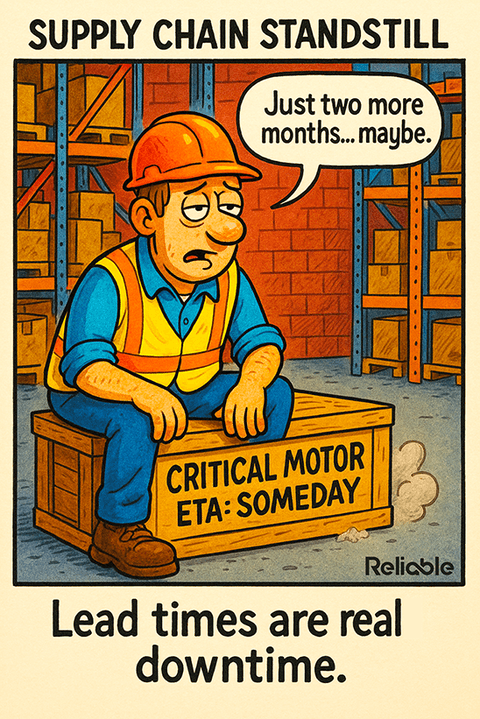
When a critical motor sits in a warehouse marked with an ETA of “someday,” production doesn’t just slow down; it grinds to a halt. Lead times, once seen as a procurement inconvenience, have now become one of the most pressing risks to operational reliability. The longer your lead time, the longer your downtime will be. And downtime is where profits evaporate. This article digs into the hard truth: supply chain lead time reduction isn’t just a procurement strategy; it’s a reliability imperative.
The Business Cost of Supply Chain Lead Times
Every maintenance and reliability professional knows downtime is expensive. However, when downtime is prolonged because a critical spare part is trapped in a congested supply chain, the costs escalate.
Lost production throughput: Each day of downtime erodes capacity.
Increased labor inefficiency: Teams remain idle or waste hours on stopgap fixes.
Higher risk exposure: Workarounds increase the chance of safety or quality incidents.
Here’s the bottom line: a long lead time converts what could have been a planned, controlled outage into a drawn-out unplanned one. Supply chain lead time reduction strategies directly determine the amount of risk your business carries when disruptions occur. One example: A paper mill in the Southeast lost more than $4M in revenue because a gearbox replacement was delayed for six weeks. While the asset was idle, the team scrambled with rented equipment that was less efficient and more costly. That’s the multiplier effect of long lead times.
Supply Chain Lead Time Reduction Through Strategic Inventory
Reducing supply chain lead times doesn’t always mean speeding up vendors. Sometimes it means buffering against their delays.
Critical spares strategy: Rank assets by criticality and stock accordingly.
Vendor-managed inventory: Push accountability upstream to suppliers.
Regional stocking points: Position spares closer to plants to cut transit lag.
Think of it this way: just-in-time works for paper clips, but not for 2,000-horsepower motors. Strategic inventory is the frontline of supply chain lead time reduction. This doesn’t mean hoarding everything. An innovative approach utilizes failure mode and effects analysis (FMEA) to identify which parts can be stored on the shelf without tying up excessive capital and which must be expedited when needed. The best organizations strike a balance: lean where it makes sense, buffered where it counts.
Building Supplier Relationships to Shrink Lead Times
Your vendors are more than order-takers; they are partners in reliability. Companies that excel at supply chain lead time reduction often do two things differently:
Dual-source agreements: Avoid being captive to a single vendor.
Collaboration contracts: Tie supplier performance metrics to uptime outcomes.
Transparency tools: Share forecasted demand so suppliers can prioritize.
A supplier who views your organization as strategic will treat your orders as a priority. A supplier who doesn’t will keep you waiting on a crate stamped “someday.” One global chemical manufacturer created a vendor scorecard tied directly to plant uptime KPIs. Suppliers who consistently hit delivery targets were rewarded with long-term contracts. Those who didn’t lose business. The result? Lead times fell by 20%, and uptime improved measurably.
Technology and Data: Turning Lead Time into Lead Advantage
Digital tools now enable predictive inventory planning and supplier risk analysis that were previously impossible. Leaders in supply chain lead time reduction use:
Predictive analytics to forecast demand based on equipment failure probabilities.
Blockchain and IoT tracking for real-time visibility of critical parts in transit.
AI-driven sourcing tools to compare vendor performance on delivery reliability.
The game is shifting: instead of reacting to long lead times, advanced plants are predicting and preventing them. By integrating reliability-centered maintenance (RCM) data with procurement systems, companies can align actual failure risk with supply chain readiness. This closes the loop between operations and supply management.
Closing Thoughts
Supply chain disruptions aren’t going away. However, organizations that treat supply chain lead time reduction as a reliability strategy, rather than just a procurement tactic, achieve more uptime, lower costs, and a greater competitive advantage. Lead times may be measured in months, but downtime is measured in millions of dollars. The difference between the two lies in how strategically you prepare.