Why Shop Floor Training Fails – And How to Build Precision Instead

After more than three decades in industrial engineering and asset management, and having trained or overseen the training of thousands of tradespeople, supervisors, planners, schedulers, resource coordinators, and reliability engineers, I’ve reached an uncomfortable conclusion:
Most of our training efforts on the shop floor have failed.
This isn’t a critique of our tradespeople. It’s not about their intelligence or willingness to learn. And it’s certainly not because the technical content is wrong—on the contrary, we’ve gotten that part right. In my own work, creating and delivering Proactive and Precision Maintenance with a Focus on FLAB—Fasteners, Lubrication, Alignment, and Balance—I’ve seen that when FLAB is executed correctly, it works every single time.
So why are the results so often underwhelming?
Because we’re teaching people to swim while strapping a weight belt to their waist, we’re training them to do things one way, then dropping them back into systems, schedules, and cultures that push them in the opposite direction.
I’ve been on both sides of this failure. I’ve been a sponsoring executive asset manager, a trainer, and a consultant. I have a holistic view, and the result is clear:
We have built systems that disable precision, not enable it.
The Illusion of Training as a Standalone Fix
The dominant model for skills development in maintenance is still classroom-based instruction. We bring workers into a seminar, deliver a few modules on lubrication best practices, torquing fasteners, or shaft alignment. Maybe there’s a certificate. Maybe there’s a quiz. And then we send them back into the field—alone, unsupported, and often expected to work faster than before.
I’ve visited sites just weeks after comprehensive FLAB training. I’ve found:
Bolted joints tightened by feel, with no torque tools in sight
Grease fittings overfilled or ignored altogether
Alignment procedures skipped in favor of “good enough”
Rotating equipment vibrating far beyond acceptable thresholds
This isn’t because the training was bad. It’s because the environment doesn’t support the behavior change we’re asking for. Many lubrication failures are not caused by knowledge gaps—they’re caused by missing resources, conflicting priorities, and broken systems.
We know what good looks like—but we haven’t built the scaffolding to hold it up.
FLAB Works — When the System Supports It
The FLAB model—Fasteners, Lubrication, Alignment, and Balance—targets four of the most common and preventable physical causes of equipment failure. These aren’t abstract engineering ideas. They’re field-level practices with real-world payback.
When implemented properly, FLAB leads to:
Fewer breakdowns and emergency callouts
Longer component and equipment life
Improved energy efficiency through reduced parasitic losses
Safer, cleaner, and more stable operations
These outcomes have been proven across industries—mining, refining, manufacturing, energy, and beyond. But they’re only achieved when FLAB is embedded into how work is done, not just what people are told.
What’s Really Missing
After decades of observation and direct involvement, I’ve concluded that sustainable precision maintenance requires three interconnected elements:
Systems that enable precision execution
Standard job plans with embedded FLAB specifications
Ongoing field coaching to reinforce behavior change
Let’s look at each.
Systems That Enable (not Disable) Productivity and Precision
Too often, our systems are disabling by design. Our CMMS platforms are bloated with junk data. Planning is under-resourced. Scheduling is driven by compliance metrics, not equipment strategy. And support functions like materials and tooling are left scrambling.
A truly enabling execution system must include:
Structured work prioritization based on asset criticality and condition
Robust gatekeeping to keep noise out of the schedule
Planning that includes FLAB specifications—not just vague task labels
Scheduling that allows enough time for quality execution
Resource coordination: the right parts, tools, and skills at the right place and time
Feedback loops to capture lessons from the field and improve future work
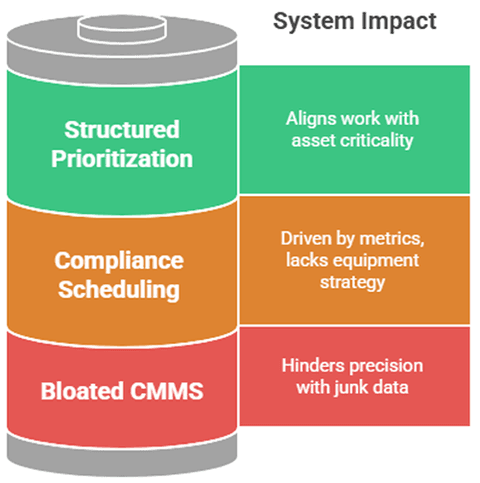
As I’ve written in Reliable Magazine, The RAM Review, and other periodicals, and discussed extensively in my Asset Management in Dollars & $ense workshop, no amount of training can overcome a system that makes precision difficult, inconvenient, or risky to attempt.
When the system disables precision, people will default to improvisation.
Standard Job Plans That Define “Done Right”
One of the most dangerous phrases in maintenance is “just tighten the bolts” or “give it some grease.” These vague instructions lead to variability, guesswork, and eventual failure. And yet, they’re still embedded in thousands of job plans across the industrial world.
A proper job plan must define “done right” in clear, specific terms. That includes:
Fastener specifications: thread condition, torque values (dry vs. lubricated), sequence, and tool requirements
Lubrication standards: lubricant type, volume, method of delivery, relube interval, and verification step
Alignment tolerances: required tools (laser or dial), target offsets and angles, soft foot values
Balance parameters: allowable unbalance (g/in or mm/s), method of correction, phase marking
Complete BOMs: including fasteners, seals, gaskets, shims, grease, and special tools
Skill levels and duration estimates: for realistic scheduling
Permits, JSAs, and inspection points: for safety and compliance
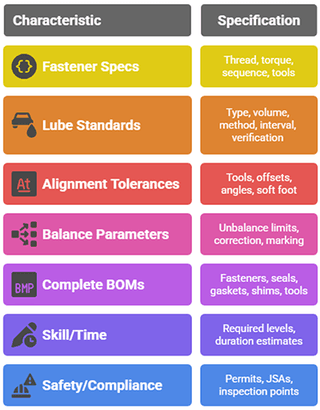
In my article Threaded Fasteners: Plant Maintenance and Reliability Best Practices (2024), I emphasized that fastener failures are rarely due to the bolt itself—they’re due to uncontrolled installation practices. The same logic applies across all of FLAB.
If the job plan doesn’t specify it, don’t expect it to happen.
Field Coaching and Mentorship
This is the missing link in nearly every organization I work with. Training is too often a one-time event. Precision, however, is a discipline—and like any discipline, it’s learned through observation, repetition, feedback, and mentorship.
Coaching must be:
Structured: tied to specific tasks and outcomes
Field-based: occurring where the work happens
Delivered by credible leaders: supervisors, engineers, and lead hands who model the right behavior
Integrated into work routines: not “added on” after the fact
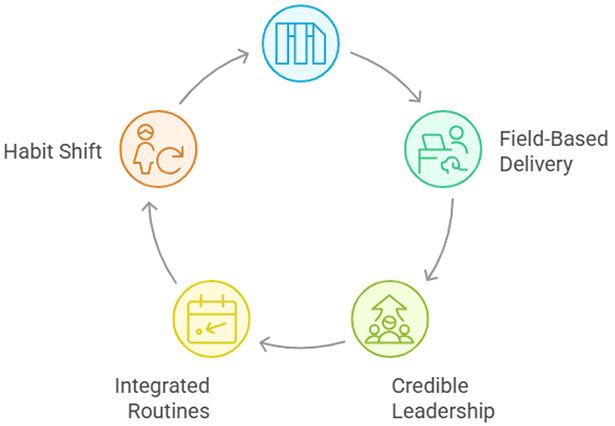
In How Prospect Theory Warps Your Maintenance Decision-Making Logic, I explored how people make decisions under uncertainty. Without reinforcement, they revert to habits and heuristics—even when they know better. Coaching is how we shift those habits in the right direction.
Culture change doesn’t happen in classrooms. It happens on the job, one coached moment at a time.
What a Supportive Culture Looks Like
The famous Peter Drucker quote, “Culture eats strategy for breakfast,” was the inspiration for my article “It’s Time to Lean In and Start Building a High Reliability Organization” (Reliable Magazine, 2025). The previously discussed systems enable precision and its associated benefits. Culture brings it to life. A supportive culture doesn’t just talk about precision—it builds it into the workflow. That means:
Rewarding jobs done to standard, not just jobs closed quickly
Giving planners and schedulers time and authority to do it right
Equipping tradespeople with the tools, parts, and information they need
Expecting supervisors to verify job quality, not just completion
Using failure data to improve standards—not just assign blame
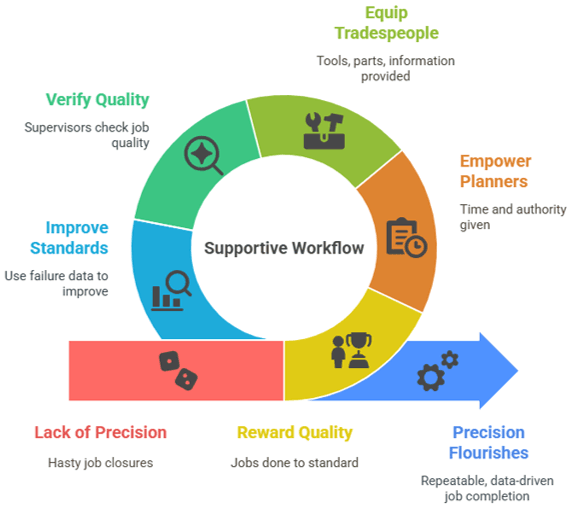
In Instill a Why-Why Culture on the Plant Floor (The RAM Review, 2020), I described how an environment of inquiry and continuous improvement builds resilience. The same applies here. Precision flourishes in a culture that asks, “What does the data say?” and “How can we make this job more repeatable?”
What Success Looks Like
In sites where FLAB is truly embedded into the way work is done, I’ve seen dramatic results:
A mining operation that cut hydraulic hose failures by 70% through improved torque and thread practices
A pulp mill that extended bearing life by 3X by overhauling its grease selection and application standards
A refinery that eliminated shaft coupling failures after implementing laser alignment and balance verification as standard procedure
Maintenance teams where over 85% of time-based and corrective jobs are executed to fully defined, FLAB-embedded plans
None of this came from training alone. It came from system design, standardization, and relentless coaching.
Final Thoughts: Stop Wasting Training Dollars
If you’re spending heavily on classroom training but not investing in job plan quality, system readiness, and coaching, you’re likely wasting money.
We don’t need more training. We need better environments for the training to take hold.
Ask yourself:
Are we enabling people to do precision work—or just expecting it in spite of our systems?
Are our job plans clear, complete, and actionable?
Are our leaders equipped and expected to coach?
Until the answer to all three is “yes,” FLAB will remain a laminated handout rather than a living, breathing practice.